Congratulations on gaining admission to a Chinese university! You are about to kick off a brand-new overseas chapter filled with brand-new courses, precious friendships, diverse gourmet experiences, and endless exploration opportunities.
Before you pack your luggage and embark on your journey to China, adequate preparation is essential. Properly sorting out official paperwork and daily necessities can greatly simplify your airport entry process and help you adapt to campus life effortlessly in the initial stage. If you are confused about pre-departure arrangements, this comprehensive guide will sort out all key preparation items for you, allowing you to start your academic journey in China with full confidence.

I. Complete Preparation of Official Documents
1. Mandatory Basic Documents
Before departure, please carefully check and prepare the following core documents to avoid entry obstacles:
– Valid personal passport – Valid X1 or X2 Chinese student visa – Official university admission notice – JW201/JW202 study confirmation form (for long-term study) or DQ short-term study information form – Original certificate of your highest academic qualification – Recent passport-sized ID photos – Physical copies and electronic backups of all certification documents
It is recommended to print multiple copies of your passport personal page, visa page and admission letter. Meanwhile, store electronic versions in your mobile phone, personal mailbox and secure cloud disk for emergency use at any time.
2. Supplementary Documents as Required
Based on your enrolled institution, major program, scholarship qualification, age and study duration, you may need to prepare additional supporting materials:
– Foreigner physical examination form and complete medical inspection reports – International student medical insurance purchase certificate – Academic degree authentication report – Scholarship award certificate and financial support proof – Payment vouchers for tuition, accommodation and insurance fees – Pre-registration completion certificate and campus registration QR code – On-campus dormitory reservation proof or off-campus housing arrangement materials – Notarized guardian authorization documents for students under 18 years old – Both old and new passports (if you renewed your passport after submitting the application) – Other original application materials specified by your university
Important Reminder: Never place original official documents in checked luggage. Put all documents in a waterproof file folder and carry it with you throughout the trip. Document requirements vary by university and major. Please always follow the latest official registration notices and email notifications released by your school.
II. Scientific Packing & Digital Account Preparation
1. Must-Carry Daily Items
Universal power adapter: China adopts a 220V/50Hz power supply system, with dual-flat and three-hole sockets as the mainstream types, so a universal adapter is a necessity.
Portable power bank: Only carry power banks with clear and complete 3C certification marks. Products without valid certification, blurred marks or recalled batches are prohibited from taking domestic flights in China.
International bank card: Prepare a bank card with enabled overseas payment function for early overseas consumption.
RMB cash: Carry a small amount of cash for airport transportation and daily emergency expenses. Note that RMB cash over 20,000 yuan or foreign currency exceeding 5,000 US dollars requires mandatory customs declaration.
Daily supplies & medicine: Prepare toiletries, personal care products and conventional medicines sufficient for the first few days of adaptation. For prescription drugs, keep the original packaging intact, carry a doctor’s prescription or medical certificate, and ensure full compliance with Chinese customs entry regulations.
There is no need for excessive packing. Daily groceries, bedding, stationery and seasonal clothes are easily accessible offline and online across China, which can be purchased after arrival.
2. Pre-Arrival Digital Setup
– Complete the online entry declaration form in advance via the official platform of China National Immigration Administration. – Download and register WeChat and Alipay, activate payment functions, and bind eligible overseas bank cards in advance. – Activate public transport QR codes (bus and subway) of your city of residence for convenient daily travel. – Get familiar with the online car-hailing functions embedded in WeChat and Alipay. – If you plan to take high-speed trains, download the Railway 12306 app, complete passport authentication and real-name verification in advance.
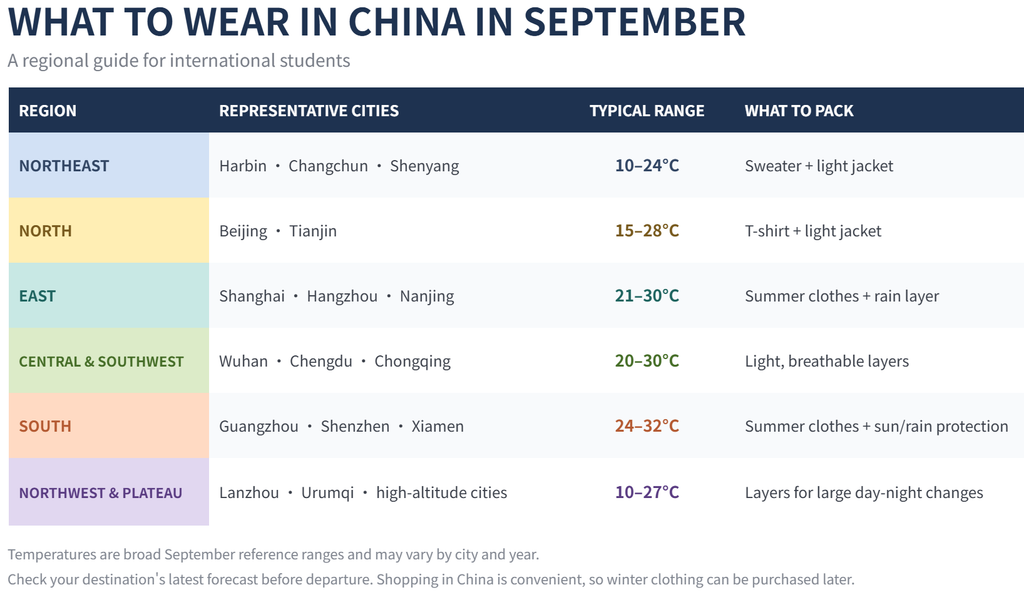
III. September Dressing Guide for Different Regions of China
China features a vast territory with distinct regional climates in September. Eastern and southern regions still retain summer warmth and humidity, while northeast and high-altitude areas usher in obvious temperature drops, with cool mornings and evenings.
You can prepare clothes according to regional climate characteristics: – Choose lightweight and breathable clothing for warm and humid southern and eastern cities. – Prepare thin sweaters and casual jackets to cope with cool weather in northern and northeastern China. – Adopt layered dressing for northwest and high-altitude regions to adapt to large day-night temperature differences. – Equip yourself with lightweight rain gear or portable umbrellas for central, eastern and southern areas with frequent autumn rains.
It is unnecessary to pack all seasonal clothes for the whole academic year. China has developed shopping malls and mature online shopping platforms, so winter clothes and seasonal supplies can be purchased locally after settlement.
IV. Guide to Experiencing Chinese Catering Culture
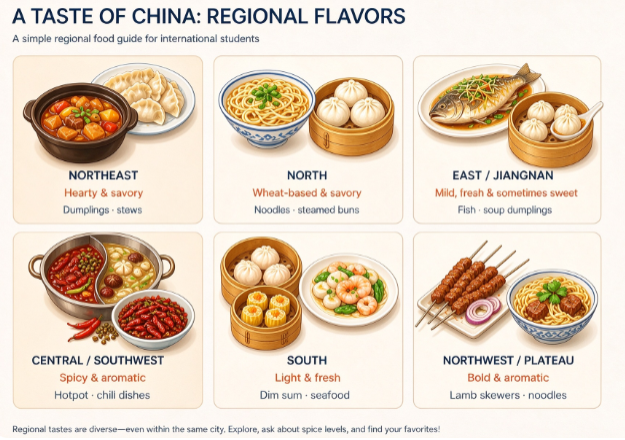
Chinese cuisine boasts rich diversity, with unique flavor characteristics in different regions, forming a colorful food culture. As you start your food exploration in China, you can master these practical tips:
If you cannot tolerate spicy food, you can take the initiative to ask merchants for “non-spicy (bú là)” or “mild spicy (wēi là)” taste. Campus canteens and urban commercial areas provide a wealth of regional Chinese dishes and international cuisines to meet diverse taste needs. Students with special dietary habits such as halal or vegetarian can consult the university in advance about supporting catering services.
You can bring a small number of sealed commercial packaged foods from your home country to adapt to the dietary transition period in the early stage. However, strictly abide by Chinese customs regulations: fresh fruits and vegetables, fresh meat and meat products, most plant and animal products are prohibited from entry. Homemade food and some dairy products also have entry restrictions. For uncertain items, please check the official customs guidelines in advance and take the initiative to declare restricted goods upon entry.
Start Your Wonderful Study Life in China
With complete document preparation, reasonable packing, smooth digital setup, and basic understanding of China’s climate and food culture, you are fully ready for your overseas study journey!
Before boarding, please keep an eye on the latest updates from your university, airline company and Chinese official authorities. Sufficient pre-departure preparation can help you complete entry and registration efficiently, so that you can devote more time to enjoying colorful campus life, making new friends and exploring the unique charm of China.
Wish you a smooth journey and a wonderful study experience in China!
发表回复