Many international students spend weeks memorizing basic Chinese greetings like “nǐ hǎo” and simple daily sentences before coming to China. Yet once you arrive, you will quickly find that real‑life scenarios such as taking online taxis, scanning codes for meals, and passing through subway gates require more down‑to‑earth language. To help you adapt to local life effortlessly and communicate with confidence in various occasions, here are ten highly practical Chinese sentences tailored for overseas students.

I. Daily Transportation
1. 手机尾号多少?Shǒujī wěihào duōshǎo?English: What are the last four digits of your phone number? Русский: Какие последние четыре цифры вашего номера телефона? Français: Quels sont les quatre derniers chiffres de votre numéro de téléphone ?
Online car‑hailing is extremely prevalent across China. To verify passenger identity before picking you up, drivers often ask for the last four digits of your phone number. Keeping this simple sentence in mind allows you to confirm your ride quickly and avoid unnecessary communication barriers.
1.jpg
2. 师傅,前面靠边停。Shīfu, qiánmiàn kàobiān tíng.English: Sir, please pull over at the roadside ahead. Русский: Уважаемый, остановитесь у обочины впереди, пожалуйста. Français: Monsieur, veuillez vous garer sur le bord de la route plus loin.
Addressing service workers such as taxi drivers as “Shīfu” is a polite and widely accepted local custom in China. When you need to stop ahead of the exact navigation destination, this natural phrase can help drivers understand your needs accurately and park safely on the roadside.
2.jpg
II. Mobile Payment
1. 扫码支付 / 出示付款码Sǎomǎ zhīfù / Chūshì fùkuǎn mǎ.English: Scan the QR code to pay / Show your payment code. Русский: Оплатите по QR‑коду / Покажите код для оплаты. Français: Scannez le code QR pour payer / Montrez votre code de paiement.
China boasts a mature mobile payment ecosystem that covers almost all consumption scenarios. For street vendors, fruit stalls and small shops, you can scan their static QR codes to complete payments. In shopping malls, supermarkets and chain restaurants, you only need to present your personal payment code for merchants to scan and charge.
3.jpg
2. 微信还是支付宝?Wēixìn háishì Zhīfùbǎo?English: Will you take WeChat Pay or Alipay? Русский: Принимаете WeChat Pay или Alipay? Français: Acceptez‑vous WeChat Pay ou Alipay ?
WeChat Pay and Alipay are the two dominant payment tools in China. Some stores only support one of the two platforms, so asking this question in advance can effectively avoid payment failures and streamline your consumption process.
4.jpg
III. Catering & Dining
1. 扫码点餐Sǎomǎ diǎncān.English: Scan the QR code to order dishes. Русский: Сканируйте QR‑код, чтобы сделать заказ. Français: Scannez le code QR pour commander vos plats.
Most restaurants in China adopt QR code self‑service ordering. By scanning the code on the dining table, you can browse menus, select dishes, adjust taste preferences and finish payment independently, which greatly saves time and reduces face‑to‑face communication pressure.
5.jpg
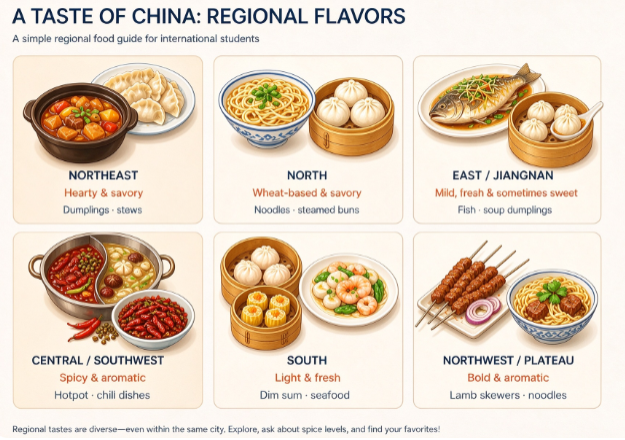
2. 这个辣吗?/ 不要辣 / 微辣 / 中辣 / 重辣Zhège là ma? / Bù yào là / Wēi là / Zhōng là / Zhòng là.English: Is this dish spicy? / No spice / Mild spicy / Medium spicy / Extra spicy. Русский: Это блюдо острое? / Без остроты / Слабая острота / Средняя острота / Очень острое. Français: Ce plat est‑il épicé ? / Pas d’épices / Légèrement épicé / Moyennement épicé / Très épicé.
Chinese cuisine features diverse flavors, with spiciness being one of the most distinctive tastes. It is common for diners to customize spiciness levels in restaurants, campus canteens and street food stalls. You can directly use these expressions to inform staff of your taste habits.
Tip: The mild spicy level in Chinese catering is already flavorful for most foreigners. It is not recommended to try extra spicy food casually to avoid discomfort.
6.jpg
IV. Social Communication
1. 我可以加你的微信吗?Wǒ kěyǐ jiā nǐ de Wēixìn ma?English: May I have your WeChat contact? Русский: Могу ли я добавить вас в WeChat? Français: Puis‑je vous ajouter sur WeChat ?
WeChat is the core social and communication platform in China, serving as the main tool for daily contact, academic communication and social interaction. Exchanging WeChat accounts is equivalent to building a stable social connection, making it the most essential sentence for making new friends in class and daily life.
7.jpg
2. 我们AA吧。(普通关系)Wǒmen AA ba.English: Let’s split the bill equally. Русский: Давайте разделим счёт поровну. Français: Partageons l’addition équitablement.
Tip: Splitting bills evenly is a mainstream and polite way of dining settlement among classmates and colleagues in China.
3. 我来付,下次你请!(亲密好友)Wǒ lái fù, xià cì nǐ qǐng!English: It’s my treat today, and you can treat me next time! Русский: Сегодня плачу я, в следующий раз угощаете вы! Français: C’est ma tournée aujourd’hui, à toi de payer la prochaine fois !
Treating friends to meals is a classic way to maintain interpersonal relationships in Chinese culture. Saying this sentence not only allows others to accept your kindness naturally without embarrassment, but also implies your expectation of future gatherings and deeper friendship.
Tip: Shared dining experiences play a vital role in integrating into local social circles. Small interactions over meals can effectively narrow the distance between people.
8.jpg
V. Campus Study & Life
1. 老师,可以把这节课的课件发给我吗?Lǎoshī, kěyǐ bǎ zhè jié kè de kèjiàn fā gěi wǒ ma?English: Teacher, could you please send me the course slides of today’s class? Русский: Учитель, не могли бы вы прислать мне слайды сегодняшнего занятия? Français: Professeur, pourriez‑vous m’envoyer les diapositives du cours d’aujourd’hui ?
Many university teachers in China do not actively upload course courseware to online learning platforms. When you miss key content or need review materials after class, this polite and standard sentence can help you successfully obtain learning resources from teachers.
9.jpg
2. 同学,我可以加入你们组吗?Tóngxué, wǒ kěyǐ jiārù nǐmen zǔ ma?English: Hi, may I join your group for the project? Русский: Товарищ студент, можно мне присоединиться к вашей группе? Français: Camarade étudiant, puis‑je rejoindre votre groupe pour le projet ?
Group cooperation and team projects are indispensable parts of university study in China. For international students who are new to the campus, this gentle and appropriate expression helps you integrate into student groups quickly and participate in academic activities smoothly.
10.jpg
Adapting to life in China is far more approachable than most international students imagine. Grasping these practical daily Chinese expressions can help you cope with various life and study scenarios with greater ease. More importantly, taking the initiative to speak and communicate bravely is the best way to integrate into local culture. Your overseas study journey in China is filled with unique warmth and surprises. Every cross‑cultural communication and every small adaptation breakthrough will become precious growth memories, making your study abroad experience unique and unforgettable.